Security-First Development: What It Actually Looks Like in Healthcare
The real decisions behind our security posture on VOSS — not the buzzwords.
Every health tech company says they take security seriously. But what does it actually mean when you're building an application that handles real patient data? When we started building VOSS, we had to answer that question in code, not in a marketing document.
Collect Less, Protect More
Before writing a single line of security code, we asked: what data do we actually need? The answer was less than we assumed. VOSS requires examination scores, timestamps, and patient identifiers to link visits. It does not need full medical histories or billing information. Our first principle: the most secure data is data that doesn't exist on your servers.
 Our approach: zero-knowledge where possible, minimal-knowledge everywhere else. We can't read what we never collected.
On-Device by Default
VOSS stores examination data on the physician's iPhone, encrypted with the device's native Secure Enclave. Not on our servers. Not in a cloud database. Cloud-first would have been simpler, but clinicians didn't ask for sync — they asked "where is my data stored?" When we said "on your phone, encrypted, nobody else," trust was established instantly.
The Lost Phone Question
Neurologists asked this most: "I left my phone in a cab. Now what?" Our answer has multiple layers:
- App-level authentication — biometric or passcode independent of the device lock screen
- Encrypted at rest — physical access to storage doesn't yield readable data
- No cloud breadcrumbs — a lost phone doesn't create a cascading breach
- Remote wipe compatible — standard iOS Find My erases examination data too
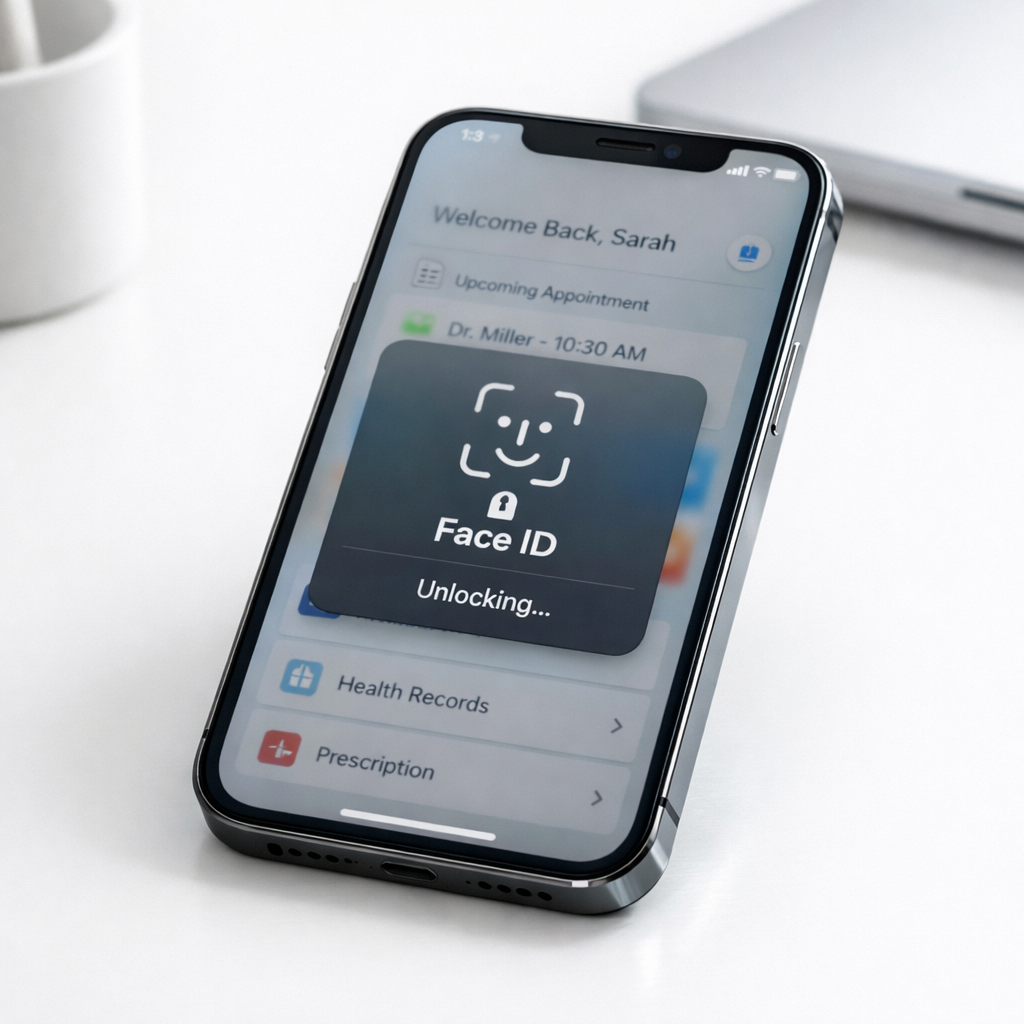 Security that's thorough enough to satisfy a clinician but invisible enough to stay out of their way.
"Good. Now show me how the scoring works." — the best possible response to a security walkthrough.
The Trade-offs We Accept
Building this way is slower. It constrains feature design. A cloud-first approach would let us ship collaborative features faster and collect richer analytics. We chose differently because in healthcare, security isn't a feature — it's the foundation. We'd rather ship fewer features with absolute confidence than ship everything with fingers crossed.
The core principles won't change: collect less, store locally, encrypt everything, and earn trust through transparency — not marketing claims.
Questions About Our Security Approach?
We're happy to discuss our architecture and design decisions in detail.
Reach Out →